
NoiseCheck
NoiseCheck is a cost-effective software-based system for measuring noise and vibration of motors, fans, gears, bearings, pumps and other electromechanical products.


Interested
For more information on NoiseCheck or to request a quote, contact our team now:
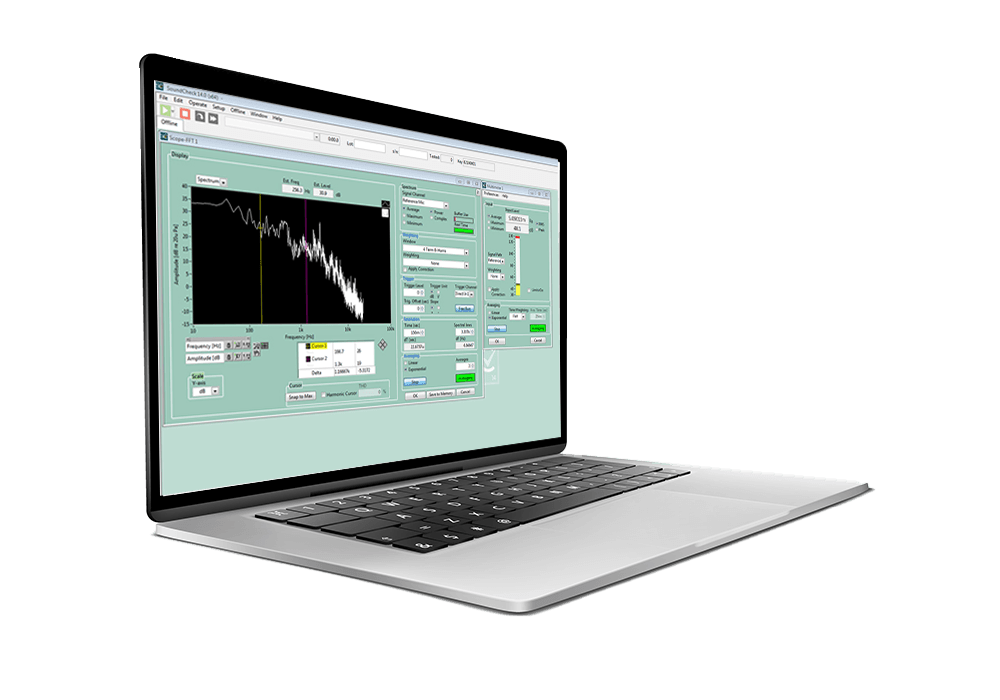
NoiseCheck ‘listens’ to the product and quantifies both the level and frequency of the noise to ensure that they are within pre-set limits. It can simultaneously carry out time-domain analysis for transient noise and frequency domain analysis for steady-state noise, replicating the human ear’s ability to hear both types of noise at once. It offers many advantages over human listeners, such as detailed fault detection analysis, clearly displaying the type and magnitude of the fault, automatic saving of data for later analysis, automated record keeping/part traceability, and can easily be integrated as part of an automated production line. NoiseCheck can also be used in the R&D lab to aid in the design of quiet products.
Operation is simple. The device under test is powered up, either using DC connect, a power supply that integrates with NoiseCheck for automated testing, (for devices requiring a power supply less that 10V DC) or an external source, and Noisecheck records the noise it produces via a microphone. If it is preferable to measure vibration rather than sound, an accelerometer or a laser vibrometer may be used instead of the microphone. For testing run up/down and variable speed products such as some fans, DC Connect can be programmed via NoiseCheck to ramp voltage up/down. The frequency counter in SoundCheck can be set to several different units including RPM, enabling correlation and graphing of noise relative to rotational speed.
Recording is started either manually (remotely) by an operator, or triggered at a given level. A spectrum analysis is performed on the recorded noise, and it is compared to pre-set limits which may either be based on a reference unit, or entered manually. NoiseCheck offers two options for analysing the signal from the DUT. The Scope-FFT includes a spectrum analyzer for measuring high resolution FFTs in the frequency domain and an Oscilloscope for measuring in the time domain. The Real Time Analyzer measures in the frequency domain by analyzing user-selectable 1/nth octave bins. The Spectrum analyzer offers high frequency resolution, and the real time analyzer offers nth octave resolution (like the human ear) and is less sensitive to fluctuations in rotation speed. Both instruments offer selectable averaging parameters to suit the application. The comparison of actual noise to pre-set limits or a reference unit is used to generate an output, ranging from a simple pass/fail signal, to a full failure mode analysis and report.
Customised test sequences are easy to develop using a simple point-and-click interface that enables complex tests to be built in a flow chart like format. Pre-programmed or user defined options are simply selected for each step in the test procedure, e.g. input voltage, recording trigger, recording time, type of analysis, output, data recording, etc.
Data is output in a variety of ways, ranging from a simple comparison to a reference unit with a PASS/FAIL indication for the production line operator, to customized reports or writing of complete test results to databases such as Microsoft® Access, SQL or Oracle® for parts traceability archiving, data-mining or report writing. NoiseCheck also features an extensive statistical analysis toolbox which can be used for Gage R&R studies including, max, min, mean, standard deviation, yield, Cpk, and Best Fit to Average.
View the NoiseCheck’s full specification at the Listen website
Applications
- Production line quality control
- Incoming inspection
- Quality assurance
- Pre and post-service evaluation
- Sound power labeling
- Component testing
- Endurance test monitoring
- Gage R and R studies
- Product design
- Component and product level testing
For R&D
Noise characteristics are an important part of the design of many products. NoiseCheck is an extremely flexible R&D test platform as its detailed results can be analyzed in many different ways and easily stored for further analyses.
For Production
NoiseCheck’s advanced algorithms allow fast and accurate testing even in noisy environments, and it is designed with automated production line integration in mind. It communicates with factory automation systems via TCP/IP and can be controlled via LabVIEW or any TCP/IP compatible programming language. It also communicates with hardware such as barcode systems and PLCs, using RS-232, IEEE-488, Bluetooth, FireWire, USB, and TTL interfaces. Test results can recorded in NoiseCheck for statistical analysis, or output to other software for full statistical process control. Within an automated environment, tests can be configured to start when the device under test is in place, and failed devices automatically removed from the production line. NoiseCheck offers various levels of test protection and operator control to protect your intellectual property and preserve test integrity. Tests can be configured for one-click testing with results compared to pre-defined pass/fail limits and clear visual and/or and audible pass/fail signals returned to the operator. Test sequences and results are easily shared, making it easy to recreate the same test throughout production facilities around the world.
SHARE THIS
Related Products
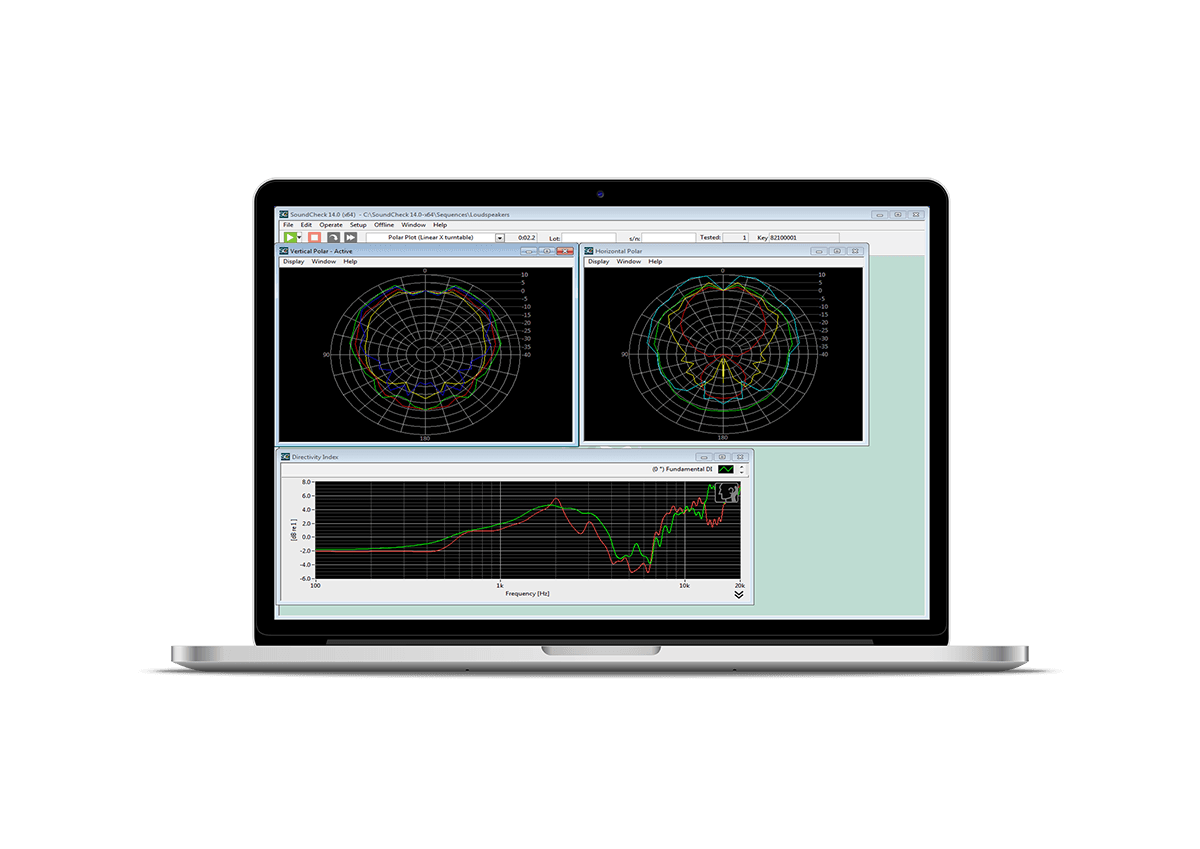
SoundCheck
The SoundCheck® system from Listen includes everything you need to perform sound quality audio measurements on a wide range of devices – the software, the…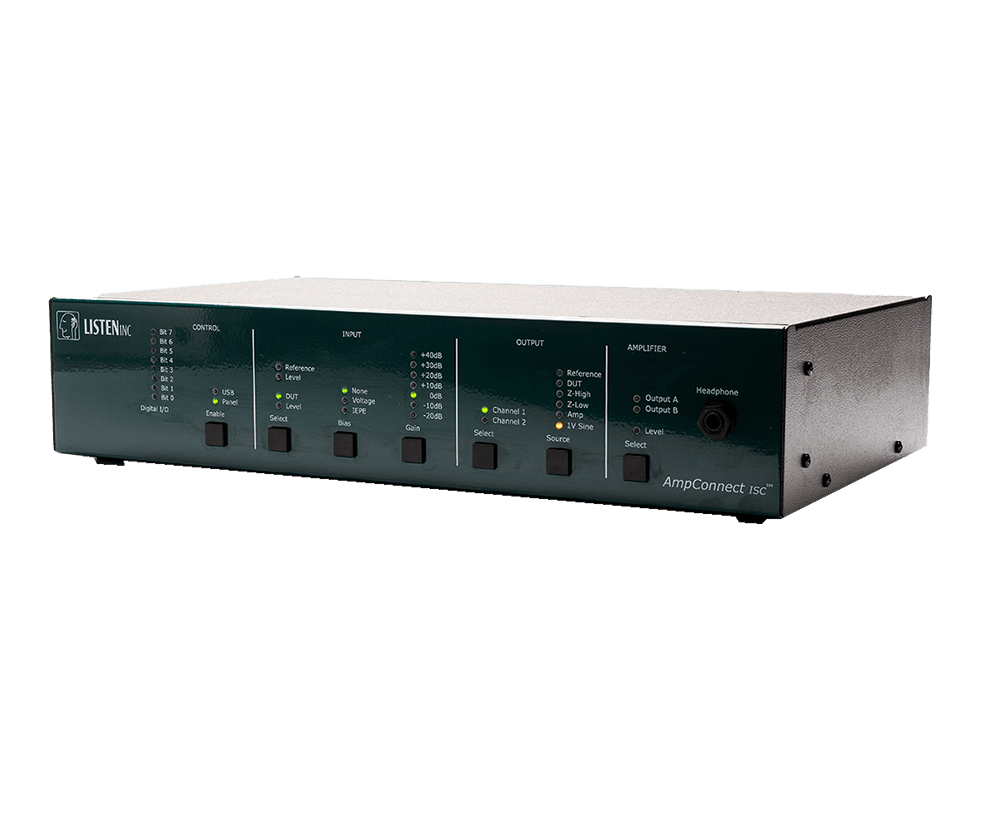
AmpConnect ISC
AmpConnect ISC is a complete, self-contained audio measurement interface which provides a complete solution for measuring speakers, headphones and microphones. Replacing multiple hardware devices, AmpConnect…
Contact Us
To contact us regarding the
NoiseCheck
Complete your details below:
Request a quote
To request a quote for the
NoiseCheck
Complete your details below:
