Understanding noise levels is an extremely important factor of R&D, NVH and general quality control. But understanding where noise is coming from, now that’s when you start to seriously understand the acoustic profile of your project.
This can be done with acoustic cameras. Now there are plenty of different acoustic imagers that are ideal for their specific application. Today we’re going to break down how the Soundcam Mikado from gfai tech fits into that space.
What Is the Mikado?
Measuring the volume of unwanted noise reveals only part of the problem. The next challenge is finding its source. The gfai tech Mikado Soundcam provides a fast, visual way to locate and analyse sound sources across a wide range of applications.
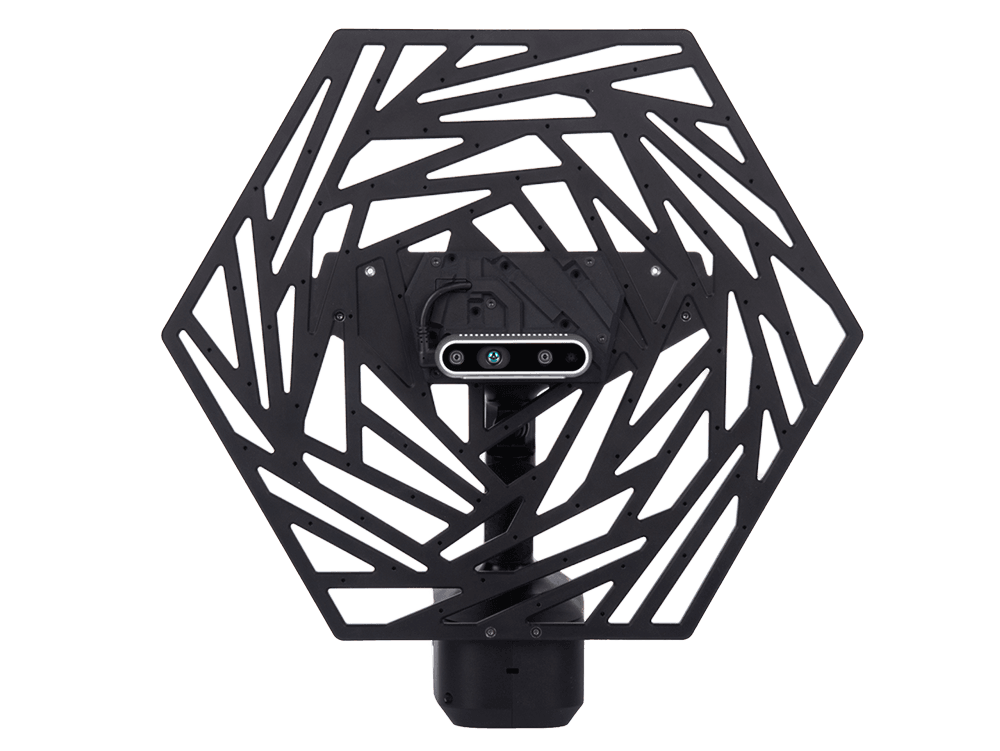
The gfai tech Soundcam Mikado is a handheld, all-in-one acoustic camera. It uses 96 MEMS microphones and a depth camera to show where noise comes from, across 10 Hz to 24 kHz.
Weighing only 2.2kg, the Mikado Soundcam is a portable, all-in-one acoustic camera with 96 digital MEMS microphones – distributed over a 35cm diameter surface – integrated data acquisition and acoustic analysis software.
Everything needed for a measurement is in the kit: the array, a DMC402L data recorder, and a Microsoft Surface Pro running NoiseImage Mobile. There is nothing to cable up.
You can record and run basic analysis on the device in the frequency and time domains, then move the data to NoiseImage Pro on a workstation for deeper work.
The system weighs 2.2kg, going up to 4.1kg with the battery and Surface Pro and measures at 40 x 40 x 18 cm. It runs from a rechargeable Bosch battery and works handheld or on a tripod. A touchscreen and a manual trigger button handle operation in the field. This small size and weight make it extremely portable and easy to move around your target.
Designed for versatile use with the option of either handheld or tripod use, paired with a dynamic range of 15 dB to 27 dB (up to 50 dB with advanced algorithms), the Mikado Soundcam lets engineers move around a test object and quickly visualise where individual sounds originate.
Acoustic imaging overlays measurement data directly onto the object being tested, making dominant noise sources easier to pinpoint than with sound-level data alone. An integrated depth camera and DynaBeam technology also create 3D acoustic visualisations, offering greater insight into sound generated across complex objects.
It has 2 methods which cover a range of distances and frequencies. Beamforming works from more than 0.3 m away. Near-field acoustic holography works at less than 0.15 m and reaches lower in frequency.
The Features That Matter Most in the Field
A 96-channel MEMS array with wide dynamics
The Mikado’s array carries 96 digital Knowles MEMS microphones over a 35cm diameter surface. Their positions are randomised and optimised by algorithm. Irregular spacing helps suppress the side lobes that show up as ghost sources on regular layouts.
This gives you a frequency response of 10Hz to 24kHz. It also gives you a 30 dB(A) noise level, 121 dB maximum sound pressure level at 10% THD, and a 9 dB to 120 dB acoustic mapping range.
Dynamic range is 15 dB to 27 dB at 1 m with 90,000 calculation points, and up to 50 dB with advanced algorithms.
What does this mean for you? It means cleaner mapping and fewer false sources. It also gives you headroom for loud machinery without clipping the quiet source you’re targeting.
Depth camera and DynaBeam 3D mapping
The array has an integrated Intel RealSense D435 depth camera. It records 1920 x 1080 video with a 77-degree opening angle and captures depth information during the measurement. The DynaBeam module builds a 3D model from that depth data and maps the acoustic information onto it.
What does this mean for you? Well, the map follows the real shape of the object. Sources on angled panels, housings and cabin interiors land on the surface they come from, and you can sweep the array by hand to cover a part rather than fixing it in one position, giving you more measurement points for higher quality analysis.
Beamforming and near-field holography in one handheld
Beamforming is recommended above 0.3 m and maps 514 Hz to 24 kHz. Near-field acoustic holography is recommended below 0.15 m and maps 30 Hz to 2 kHz.
And this pairing is a deliberate choice from gfai tech. At low frequencies, beamforming is limited by main lobe width and array size. Holography at close range offsets that limit.
What does this mean for you? It means that, with one device, you can cover tonal low-frequency problems up close and mid to high frequency sources at a distance. This means that you don’t need to have multiple systems for when the problem sits below the range that beamforming allows.
Analysis on the device, with channels for other sensors
To make the Soundcam Mikado easier to use and better designed for analysis, the camera syncs up to NoiseImage Mobile which runs on a Surface Pro.
You can still record and analyse on the spot in the frequency and time domains. Sampling is 48 kS/s across the 96 channels, and four isolated digital inputs let you record additional sensors alongside the acoustic data. NoiseImage Mobile correlates that data with the acoustic signals in post-processing.
For longer analysis, the data moves to NoiseImage Pro. The wider NoiseImage suite lists modules for power beamforming, psychoacoustics and sound quality, pass-by, wind tunnel work, and nearfield imaging. Check with AcSoft which modules apply to Mikado data.
What does this mean for you? This set up, gives you a first answer in the field, and a route to a full analysis without re-measuring.
Where Can the Mikado Be Used?
The Mikado Soundcam supports applications across research, development, manufacturing and electronics, including the following areas.
Automotive and Aerospace
Vehicles and aerospace systems contain many potential noise sources, including motors, fans, HVAC systems, pumps and mechanical components.
The Mikado Soundcam helps engineers locate unwanted noise, rattles and components that contribute to overall sound levels, making it valuable for NVH testing, development and troubleshooting.
Automotive NVH. Locate sources in the cabin and engine bay. gfai tech positions the Mikado for three-dimensional acoustic maps of a car interior or motor compartment.
Aerospace and wind tunnel work. Distributor material describes aero acoustic analysis in wind tunnel testing.
Machinery and Manufacturing
When machinery develops an unusual noise, identifying its exact origin can be difficult.
The Mikado Soundcam quickly narrows the source to individual motors, pumps, fans or other moving parts, supporting maintenance, troubleshooting and product development.
Appliances and Electronics
Vacuum cleaners, washing machines and other electrical appliances may contain several sound-generating components.
Acoustic imaging shows whether noise comes from a motor, fan, housing, pump or mechanical connection, helping engineers improve product design, sound quality and performance.
Product R&D. Close-up holography at less than 0.15 m suits housings, PCBs, motors and appliances, down to 30 Hz.
Research, Development and Quality Control
During product development, the Mikado Soundcam helps engineers compare prototypes, evaluate design changes and understand how individual components affect a product’s acoustic performance.
The Mikado Soundcam supports consistent quality control by identifying unusual acoustic variations between products or components.
Quality control. Compare a good unit against a faulty one. NoiseImage can place two acoustic images side by side for a nominal against actual check.
Soundcam Mikado: Case Studies
An Inter-Noise conference paper used a Mikado with 96 MEMS microphones sampling at 48 kHz. The team placed the array parallel to a rigidly mounted brake disc, 8 cm from the surface.
They calculated near-field acoustic maps in NoiseImage and used SONAH to reproduce mode shapes at 220 Hz, 235 Hz, 560 Hz and 1000 Hz. A high-speed camera ran alongside to compare against the optical vibration data.
The paper also records the limits. Holography needs access to the near field and accurate alignment, which matches the datasheet’s 0.15 m recommendation. It is a research setup, but it shows the Mikado holding up in work that goes beyond source location.
Specification
| Item | Value |
| Microphones | 96 digital MEMS (Knowles), 35 cm diameter surface |
| Frequency response | 10 Hz to 24 kHz; 100 Hz to 5 kHz (less than 0.5 dB); 100 Hz to 11 kHz (less than 3 dB) |
| Maximum sound pressure level | 121 dB at 10% THD |
| Noise level | 30 dB(A) |
| Sensitivity (1 kHz, 94 dB SPL) | -26 dBFS |
| Sampling rate | 48 kS/s |
| Additional channels | 4 digital |
| Video camera | Intel RealSense D435, 1920 x 1080, 77 degree opening angle |
| Recommended measurement distance | More than 0.3 m (beamforming); less than 0.15 m (holography) |
| Recommended mapping frequencies | 514 Hz to 24 kHz (beamforming); 30 Hz to 2 kHz (holography) |
| Acoustic mapping range | 9 dB to 120 dB |
| Dynamic range (1 m, 90,000 points) | 15 dB to 27 dB; up to 50 dB with advanced algorithms |
| Dimensions | 40 x 40 x 18 cm; 40 x 40 x 27 cm with Surface |
| Weight | 2.2 kg; 4.1 kg with battery and Surface |
| Ingress protection | IP40 |
| Operating environment | 0 to 35 °C handheld; -10 to 45 °C desktop |
| Power | Rechargeable Bosch battery; AcSoft quotes up to three hours per battery |
See Where Sound Is Coming From
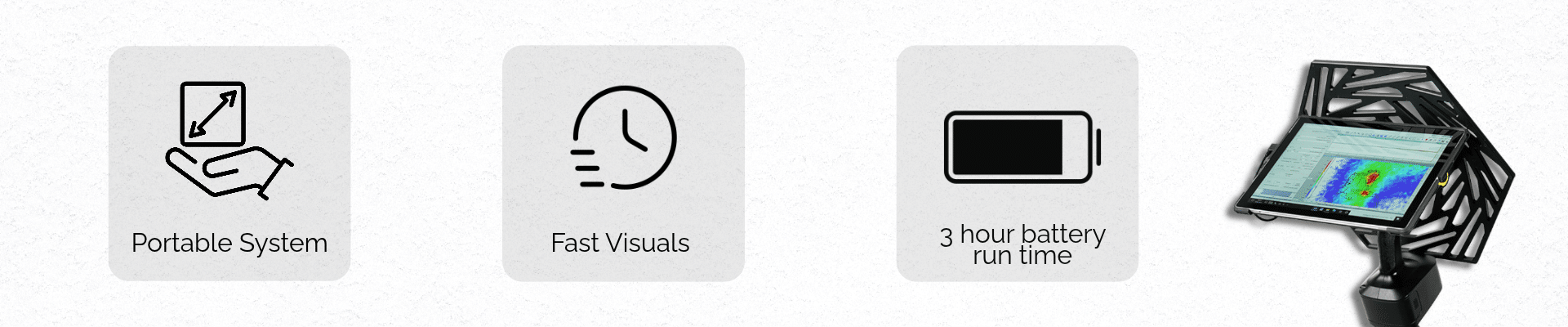
The Mikado Soundcam combines acoustic measurement and visualisation in one portable system.
Whether tracking a vehicle rattle, investigating machinery, analysing a new product or searching for a leak, it offers a fast, visual way to understand complex sound sources.
Sometimes hearing the problem is not enough—you need to see where it comes from.
If you want more information, or want to discuss the wide range of acoustic imaging products that AcSoft proudly supplies, get in touch with our experts today.
Want to learn more about the Mikado Soundcam
Watch our video on the gfai Mikado Soundcam to see it’s key features and how it’s different applications can support troubleshooting, testing, R&D and quality control.