

NVH Engineers face acoustic challenges every day. This could be troubleshooting noise, optimising products or improving soundproofing.
Identifying the true source of unwanted sound is rarely straightforward. Traditional acoustic measurements can tell you how loud something is, but they often struggle to clearly show where the noise is coming from.
In complex systems, sound reflects off surfaces, travels through structures, and interacts with surrounding components. This makes isolating the root cause of a problem difficult and time-consuming.
This is why sound visualisation is so important.
Instead of relying purely on sound level measurements, engineers can map acoustic behaviour directly onto the object being tested. This transforms complex data into something that can be easily understood and acted upon.
This has become an increasingly common solution in recent years and at the forefront of it is Scan&Paint 2D.
Why Sound Visualisation Matters
Graphs, spectra, and measurement tables provide important information, but they can make it difficult to clearly communicate where noise is being generated or how it behaves. Sound mapping solves this problem by overlaying acoustic data directly onto an image of the device under test.
This allows engineers to understand how sound is behaving on a surface. Allowing them to:
- Identify dominant noise sources
- Detect sound leakage paths
- Understand vibration-to-noise interactions
- Compare design changes or product variations
Introducing Scan&Paint 2D
Scan&Paint 2D, made by Microflown, is a powerful yet straightforward system that is designed to assist engineers in their acoustic diagnosis of products in R&D, product testing, NVH and more. But how does it work?
The process is simple.
A particle velocity probe is manually moved across the surface of the object while a camera records the scanning process. The system then synchronises the audio data and the video recording, allowing the probe position to be tracked in real time using infrared technology.
The results are high resolution sound maps of stationary sound fields and display this on a 2D image of the surface that is being diagnosed. This allows users to quickly identify noise sources across a wide frequency range.
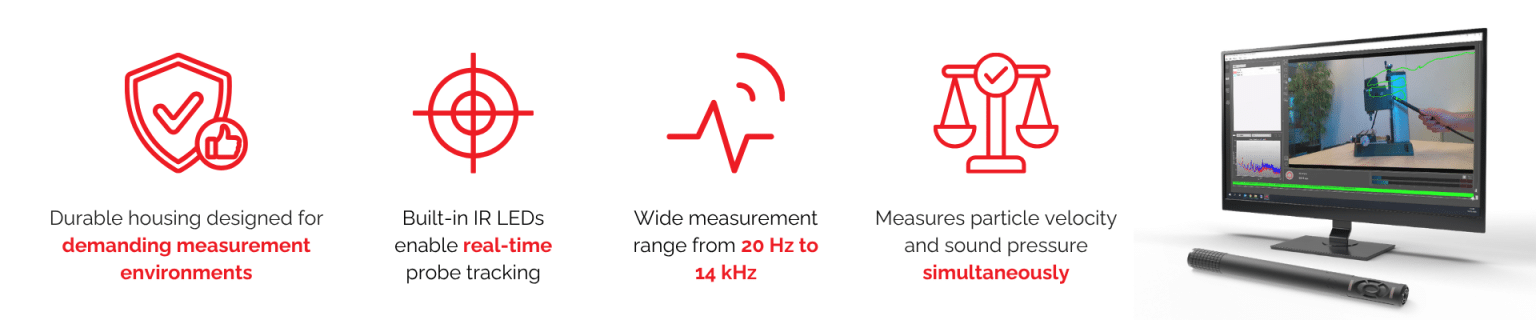
The Key Features of Scan&Paint 2D
Key capabilities include:
- Broadband measurement range – 20 Hz to 14 kHz
- High-resolution sound mapping
- Visualisation of particle velocity, sound intensity, or sound pressure
- Fast setup, measurement, and processing
- Portable single-sensor solution
- Suitable for real operating environments, including reverberant spaces
- Sound power calculation capabilities
Measurements can typically be completed within minutes, making it an ideal tool for rapid acoustic investigations.
The Tech Behind Scan&Paint 2D
At the core of the system is the PU Gen2 probe, designed specifically for Scan&Paint 2D applications. The probe measures both particle velocity and sound pressure. By combining these 2 measurements, the system can calculate sound intensity, allowing for engineers to determine both the magnitude and direction of acoustic energy.
The probe has a high dynamic range, a rugged design for demanding environments and offers compatibility with Class 1 sound calibrators.
Real-Time Probe Position Tracking
Scan&Paint 2D uses infrared tracking technology to monitor the exact position of the probe during scanning. This probe has integrated IR LEDs that work with an Intel RealSense camera to capture the probes movement in real time. This means the software can accurately reconstruct the measurement path and generate detailed sound maps without requiring complex positioning equipment.
The result is a simple but highly effective measurement method that can be used directly in the field.
Fast Setup and Portable Design
One of the reasons so many professionals use Scan&Paint 2D is that it is so easy and quick to be deployed. The entire system fits into a single portable case, making it easy to transport to different testing environments.
Setup typically takes only a few minutes, simply connect the probe, connect the camera and launch the software.
Once configured, engineers can begin scanning immediately and generate results shortly after completing the measurement.
Clear and Easy-to-Understand Results
One thing that engineers often bring up is the way in which they want to understand and present their data, Scan&Paint 2D offers a unique way of presenting acoustic data in a clear and visual way. Instead of analysing complex datasets, results are displayed as high-resolution sound maps directly overlaid onto an image of the device under test.
This makes it much easier to:
- Identify noise sources
- Communicate findings to colleagues or clients
- Demonstrate the effectiveness of design changes
Even non-acoustic specialists can quickly understand the results.

How Scan&Paint 2D Benefits Your Work
Beyond its technical capabilities, Scan&Paint 2D delivers practical benefits for engineers and acoustic professionals, such as faster troubleshooting, improved communication which ultimately leads to better product optimisation.
By mapping sound directly onto the surface of the object, engineers can quickly identify dominant noise sources without lengthy analysis. This is then displayed in visual sound maps that make it far easier to explain acoustic problems and solutions to colleagues, management teams, or clients. With this data, engineers can pinpoint exactly where noise is generated, allowing them to target design improvements more effectively.
This leads to quieter products, better performance, and faster development cycles.
If you’d like to learn more about Scan&Paint 2D or see how it could support your acoustic investigations, get in touch with our team or explore the system in more detail.