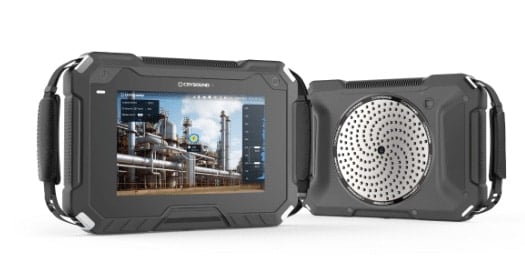

Electrical insulation failures are a major concern in high-voltage systems. One of the early warning signs of insulation degradation is partial discharge—a localized electrical discharge that can lead to equipment failure if left unchecked.
Now for years, the way to find partial discharge has been with High-Frequency Current Transformers (HFCT) and Transient Earth Voltage (TEV) Sensors. Now they may have been the go-to in recent years, but they have significant limitations.
For example, HCTF’s require physical access to cables, meaning increased risk and increased time to find the problem. It also can’t pinpoint the exact location of the discharge. It’s also not effective for aerial power lines or sealed enclosures.
It’s the same story with TEV sensors. They only work for metal enclosures, not open air or underground assets. They also don’t provide visual representations of the discharge location.
Now, wouldn’t it be so much easier if there was a single solution that not only worked in all areas, but didn’t require physical access to cables AND pinpointed the exact area where the discharge was occuring.
That’s why acoustic imaging cameras have become the newest and most powerful solution to partial discharge.
And as far as acoustic cameras go, there isn’t much that touches the CRY8124 in both functionality, ease of use and price.
How the CRY8124 is Changing the Game in Partial Discharge
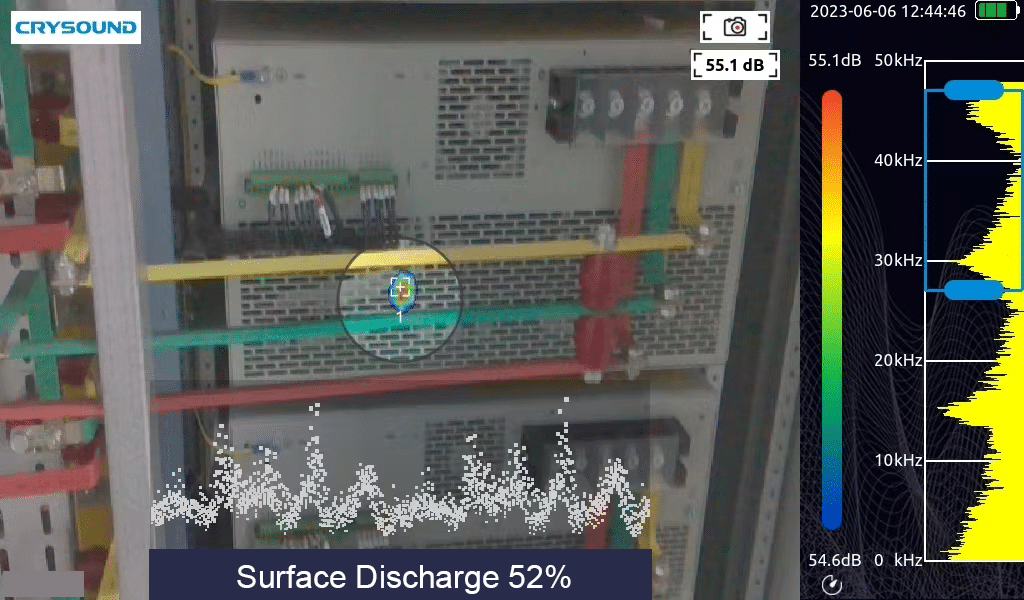
The CRY8124 Acoustic Imaging Camera is designed to detect and classify different types of partial discharge through its advanced PRPD (Phase-Resolved Partial Discharge) intelligent recognition system.
It also pinpoints discharge locations visually, even in noisy industrial environments, ensuring precise fault detection without the need for direct contact.
Previous Applications of The CRY8124
So where has this camera already been applied to solve partial discharge?
- High Voltage Substations – It identified insulation degradation in transformers, switchgear and power lines
- Industrial Facilities – The camera monitored high-voltage cabinets, motors, and power filters to prevent unexpected failures
- Active Power Filters (APFs): The CRY8124 was also able to detect partial discharge in APFS, these are essential for harmonic suppression and reactive power compensation.
What makes the CRY8124 Unique when Detecting Partial Discharge?
Real Time Acoustic Imaging – The CRY8124 can instantly visualise discharge locations with high resolution imaging, saving you valuable time.
PRPD Intelligent Recognition: One unique feature of the CRY8124 is that it classifies different types of partial discharge for targeted maintenance.
Dual Thermal and Acoustic Imaging: The CRY 8124 combines thermal imaging with acoustic detection, allowing simultaneous visuals of thermal and ultrasonic data. This is especially useful in hot environments, where identifying temperature patterns aids in troubleshooting.
Operating up to 10 hours with replaceable batteries, the CRY 8124 is designed for continuous use in large facilities. Wireless data transfer and advanced reporting software simplify documentation, allowing for seamless sharing of inspection data.
Long-Range Detection: Identifies discharges from a safe distance without the need for direct contact.
Saving you time and money.
One of the best features of the CRY 8124 is it’s reporting capabilities. This camera is able to produce a report which would typically take hours, in just a few minutes. With information on the the type of partial discharge, the DB, the location and even more. All presented in an easy-to-read PDF with images of the leak included too.
So not only are you saving time on detecting the leak, but you’re also saving time on reporting on the leak. Altogether, you can do what could be a full days work in mere minutes with this camera.
Now imagine spreading this over a large area, you could be saving hundreds of thousands of pounds in working hours and discharge management.
To find out more check out the CRY8124 or speak with our team