
Waste-to-Energy (WtE) plants are essential for converting municipal solid waste (MSW) into steam, which powers electric generator turbines. This process supports both waste management and renewable energy production, making it a crucial part of sustainable infrastructure.
However, maintaining efficiency and more importantly, safety in these facilities relies on the complete control over the negative pressure that is produced in these plants. Any leakage in the incinerator system can result in hazardous emissions, environmental pollution, and safety risks for workers.
Negative pressure in WtE plants ensures that combustion gases remain contained within the system. When leaks occur, these gases can escape, releasing pollutants and reducing the efficiency of the incineration process.
The Old Way of Detecting Leaks in Waste-to-Energy Plants…
Traditional ways of detecting leaks in waste-to-energy plants, such as manual leak detection or infrared cameras, often fall short due to the following reasons.
They are difficult to assemble, meaning that across a large scale facility with extensive ductwork, manual inspections would be incredibly time consuming and expensive…
IN high temperature environments, inspectors are often exposed to dangerous conditions due to not being able to work with incinerators from a distance.
They also have limited detection capabilities, meaning some leaks are too small to even be detected by conventional methods. This leads to lost energy and ongoing safety hazards that could get worse if not addressed.
The Solution? Acoustic Imaging
This is why acoustic imaging has been recently introduced to this industry. This is a method of using the ultrasonic sound emitted from these leaks to detect where they are coming from.
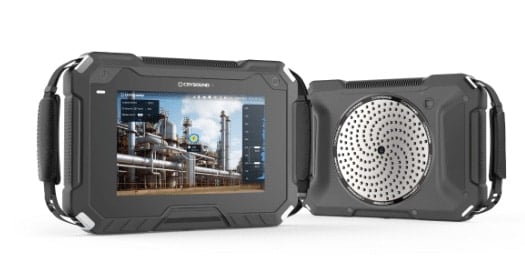
And this is all performed by tools like the CRY8124. A handheld acoustic imager that is capable of not only detecting the leaks, but producing detailed yet easy to digest reports that show the exact location of the leak, the flow rate and even the type of gas that is leaking out.
What areas was the CRY8124 Effective in When it has Previously Been Used Detecting Leaks in Waste-to-Energy Plants?
- Remote Testing Capabilities: The camera was able to inspect from a safe distance without exposing workers to high-temperature areas.
- Wide-Area Coverage: It could also scan large sections of the facility in minutes, detecting multiple leaks in a single pass.
- Real-Time Visualization: The CRY8124 was able to instantly locate the leaks using acoustic imaging, ensuring a rapid response and quick mitigation.
- HyperVision Technology: These plants are often extremely noisy, the camera was able to filter out background noise, isolating leak sounds for accurate identification.


In these images, we can see that the CRY8124 is incredibly accurate when detecting leaks in waste-to-energy plants, showing the exact location of the leak. And these leaks would also be reported on automatically by the camera, giving you an easy to read, yet detailed review on where your leaks are, allowing you address them quickly and efficiently.
What makes the CRY8124 Unique in Detecting Leaks in Waste-to-Energy Plants?
Real Time Acoustic Imaging – The CRY8124 can instantly visualise leak locations with high resolution imaging, saving you valuable time.
Dual Thermal and Acoustic Imaging: The CRY 8124 combines thermal imaging with acoustic detection, allowing simultaneous visuals of thermal and ultrasonic data. This is especially useful in hot environments, where identifying temperature patterns aids in troubleshooting.
Operating up to 10 hours with replaceable batteries, the CRY 8124 is designed for continuous use in large facilities. Wireless data transfer and advanced reporting software simplify documentation, allowing for seamless sharing of inspection data.
Long-Range Detection: Identifies discharges from a safe distance without the need for direct contact.
Saving you time and money.
One of the best features of the CRY 8124 is it’s reporting capabilities. This camera is able to produce a report which would typically take hours, in just a few minutes. With information on the the type of leak, the DB, the location and even more. All presented in an easy-to-read PDF with images of the leak included too.
So not only are you saving time on detecting the leak, but you’re also saving time on reporting on the leak. Altogether, you can do what could be a full days work in mere minutes with this camera.
Now imagine spreading this over a huge plant? You could be saving hundreds of thousands of pounds in working hours and discharge management and even save lives in the process.
To find out more check out the CRY8124 or speak with our team